
Products · Power generation
Turbine bolts and studs
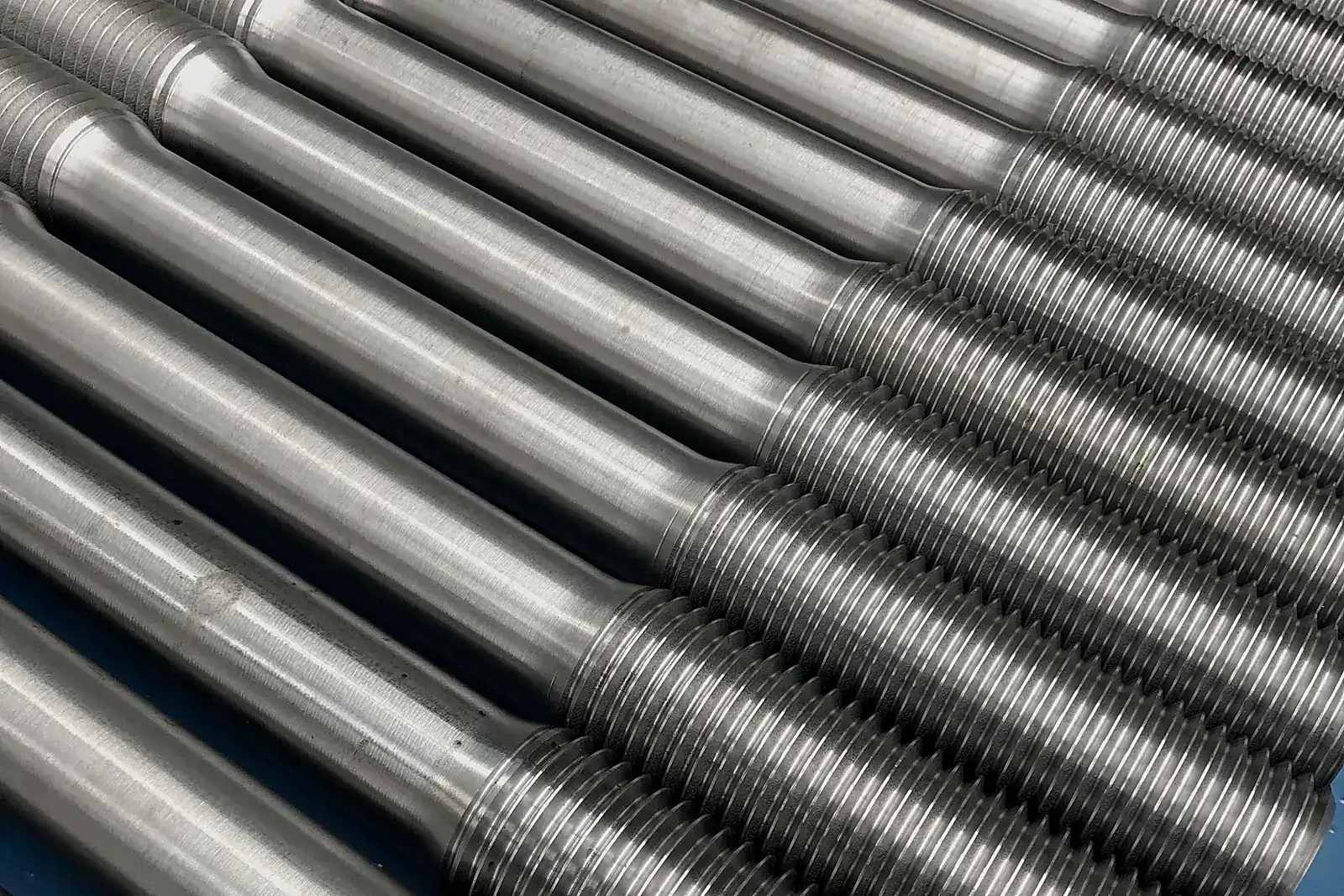
Turbine bolts, studs and nuts for steam, gas and hydro turbines, made in the UK in Durehete, B16, Nimonic 80A and other creep resisting grades. Made to older CEGB standards, the turbine maker’s drawing or current specifications, or copied from your used studs for outage repairs.
Durehete
900, 950 and 1055 turbine bolting
CEGB
Legacy standards still made when asked
1971
Supplying British power generation since
3.1 / 3.2
EN 10204 certificates with full traceability
About turbine bolting
Turbine studs that hold their load at temperature
Turbine studs and bolts hold together the casing halves, valve chests, steam chests and couplings of steam and gas turbines. These joints stay hot for months between outages. An ordinary steel slowly creeps at that temperature and its clamp load relaxes, so turbine bolting is machined in creep resisting grades and heat treated to tight limits.
Many of the turbines HAGUE FASTENERS LIMITED supports were built decades ago, so their bolting is often called up to older CEGB (Central Electricity Generating Board) standards or the original maker’s drawings. We still make to these legacy standards whenever they are asked for, which is often for outage repairs, as well as to current British, European and ASTM specifications. Where no drawing survives, we copy a used stud from the strip-down.
What we make
- Casing, valve chest and steam chest studs
- Waisted studs with reduced shanks
- Studs with heater holes for heat tightening
- Studs with gauge holes for measuring stretch
- Coupling bolts and fitted bolts
- 12-point bolts, cap nuts and sleeve nuts
- Hydro and wind turbine bolting to drawing
Durehete
Durehete turbine bolting, a HAGUE FASTENERS speciality
Durehete is the historic trade name of a family of creep resisting alloy bolting steels (900, 950 and 1055) made in the UK and used on British steam turbines for decades, and still called up on many turbine drawings and CEGB standards. HAGUE FASTENERS LIMITED makes studs, bolts and nuts to all three grades, with heat treatment and testing through our approved partners and full traceability from the mill.
Durehete 1055 is comparable with 20CrMoVTiB4-10 (1.7729) in EN 10269 and is used for the hottest bolted joints, where B16 is not enough.
New material for Durehete duties. The Durehete grades are no longer made under the trade name, so bar sold as Durehete is now hard to find. HAGUE FASTENERS LIMITED is drafting its own specification so that new material can be certified for Durehete duties, starting with Durehete 1055 to EN 10269 (1.7729) with supplementary requirements and EN 10204 3.2 certificates. Ask us if your next outage calls for Durehete.
Read more about Durehete bolts, studs and nuts and Durehete 1055 fasteners, or see the full range of carbon and alloy steels we use.
Options
Standards, forms and testing
Typical options. We make to your specification, drawing or sample.
| Option | What we make |
|---|---|
| Standards | Older CEGB standards, the turbine maker’s drawing or pattern, BS 4882, ASTM A193, ASTM A453, EN 10269, or copied from a used stud |
| Forms | Double-ended and waisted studs, heater holes, gauge holes, coupling bolts, 12-point bolts, cap nuts and sleeve nuts |
| Threads | Metric, UNC, 8 thread series (8UN), BSW, BSF and other legacy forms to drawing |
| Testing | Elevated temperature tensile and stress rupture, hardness, Charpy impact, MPI and ultrasonic testing |
| Documentation | EN 10204 3.1 or 3.2 certificates, laser-marked heat codes, dimensional reports |
CEGB standards we make to
The CEGB high temperature bolting series covers bolting for steam and fluid design temperatures of 371 to 580°C. HAGUE FASTENERS LIMITED still makes to these standards, and to their later GDCD designations, whenever they are called up, which is often for outage repairs.
| Standard | Covers |
|---|---|
| CEGB 02596 (later GDCD Standard 2) | 1 chromium, 1 molybdenum, ¾ vanadium steel bars for high temperature bolting, used for Durehete 1055 |
| CEGB 02597 (later GDCD Standard 3) | ½ molybdenum, ¼ vanadium steel bars for high temperature bolting, used for Durehete 950 |
| CEGB 02598 (later GDCD Standard 4) | 1 chromium molybdenum steel bars for high temperature bolting, used for Durehete 900 |
| CEGB 02599 (later GDCD Standard 5) | 12 chromium, molybdenum, vanadium, niobium steel bars for high temperature bolting (U43) |
| CEGB 025910 (later GDCD Standard 6) | Nickel base (19.5 chromium, 2.2 titanium, 1.4 aluminium) alloy bars for high temperature bolting, Nimonic 80A (U44) |
| CEGB 025902 | High temperature bolts (BSF) |
| CEGB 025903 | High temperature studs (BSF) |
| CEGB 025904 | High temperature studbolts (BSF) |
| CEGB 027802 | High temperature cap nuts, hexagon nuts and round nuts (BSF) |
| CEGB 028801 | High temperature washers |
Materials
Turbine bolting grades
The grade supplied always follows your specification. See all fastener materials.
| Grade | Typical use |
|---|---|
| Durehete 900, 950 and 1055 (CEGB 02598, 02597 and 02596) | Creep resisting bolting for steam turbine casings and valve chests; 1055 for the hottest joints |
| ASTM A193 B16 and BS 4882 B16A | High temperature bolting above the range of B7, typically from about 400°C up to around 520°C |
| AISI 422 and Jethete M152 | Martensitic stainless bolting where strength and corrosion resistance are both needed |
| A286 (ASTM A453 660) | Long-term service up to about 540°C, and higher where loads are lower |
| Nimonic 80A | Nickel alloy bolting for the highest temperatures, including gas turbines |
| Inconel 718 | High strength nickel alloy bolting |
Outages and repairs
Replacement turbine studs when the clock is running
A seized or cracked stud found on strip-down cannot wait months. Send us the stud schedule, a drawing or a used stud. We hold stocks of Durehete, B16 and superalloy bar, so outage and breakdown orders can start straight away, turned and threaded in our own Willenhall facility.
- Used studs measured and copied when no drawing survives
- Heat numbers traced from mill to release
- Heat treatment, NDT and testing by approved partners
- Nuclear safety-critical parts released under First Level QC1 procedures
Related
Related products and pages
Questions
Frequently asked questions
What are turbine studs?
Turbine studs bolt together the casing halves, valve chests and other joints of steam and gas turbines, which stay at high temperature between outages. They are machined to the turbine maker’s drawing in creep resisting grades so they keep their clamp load.
Can you make turbine bolts to old CEGB standards?
Yes. Many UK plants still call up older CEGB standards or the original maker’s drawings, especially for outage repairs, and we make to them when asked, for example CEGB 025902, 025903 and 025904 for high temperature bolts, studs and studbolts (BSF), as well as to current BS, EN and ASTM specifications.
Can you copy a used turbine stud?
Yes. Send us a used stud from the strip-down and we will measure it and make replacements to match, in the grade and to the standard you specify.
What is Durehete?
Durehete is the historic trade name of a family of creep resisting alloy bolting steels (900, 950 and 1055) used for UK steam turbine bolting. The grades are no longer made under that name. Durehete 1055 is comparable with 20CrMoVTiB4-10 (1.7729) in EN 10269, and HAGUE FASTENERS LIMITED is drafting a specification so that new material can be certified for Durehete duties.
Why do some turbine studs have a hole down the middle?
It is a heater hole. A heating rod is put into the stud to stretch it before the nut is tightened, and as the stud cools it holds the clamp load. Studs can also have gauge holes so the stretch can be measured. We make both to drawing.
Can you make turbine studs during an outage?
Yes. With Durehete, B16 and superalloy bar in stock, outage and breakdown orders can start straight away, with heat treatment and testing managed through our approved partners.
Do you make wind turbine bolts?
We make hydro and wind turbine bolting to drawing. Most of our turbine work is high temperature bolting for steam and gas turbines.
Planning an outage?
Send us the stud schedule, a drawing or a used stud
Tell us the grade, standard, sizes, quantity and test requirements and we will quote quickly.